
The short answer: in and around Spokane you can currently buy microgreens in Spokane Valley, heritage grain from the Palouse, and beef by the cut or by the quarter from Connell. Prices and producers are below, checked on 1 October 2026.
This is a working list, not a directory. Every producer named here has stock on FarmToYou today and sets their own prices. Where a farm sells something unusual, or in a size most guides quietly skip over, we have said so rather than rounding it into "fresh local produce".
Spokane Valley: microgreens, cut to order
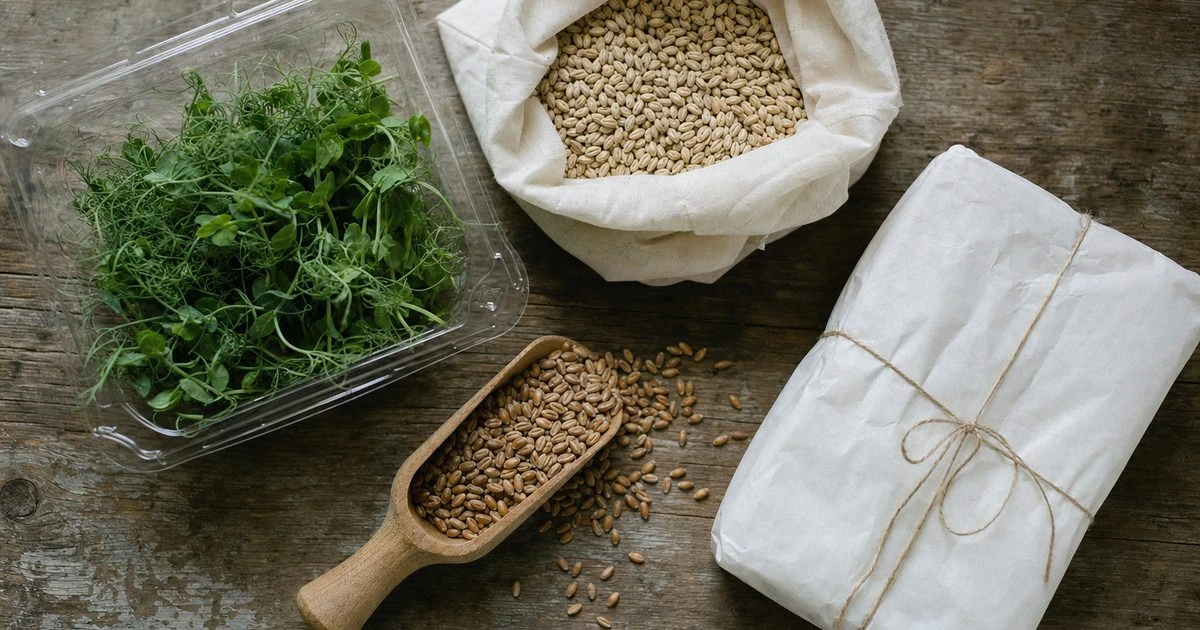
Madre Gaia Organics grows microgreens in Spokane Valley, immediately east of the city. Five varieties are listed at $8.00 each: arugula, broccoli, sunflower, pea shoots, and a crunchy micro mix. They come in 2 oz compostable clamshells, with a minimum order of five that you can mix and match. Most of it is grown to order, so allow about 10 to 14 days.
Microgreens are the one local crop where the freshness argument is not marketing. They are harvested days old and lose condition quickly, which is exactly why the supermarket version costs what it costs and arrives when it arrives. Buying them from ten minutes away is a genuinely different product, not the same product with a better story.
See what Madre Gaia Organics has in stock.
Illustrative image.
The Palouse: heritage grain you mill yourself
Palouse Heritage Mercantile farms at Endicott, southwest of Spokane, and sells landrace and heritage grains as whole berries rather than flour. English Redhead Wheat Berries are $18.95. White Sonora, Turkey Red, and Elwha River Spelt berries are $19.95 each, as is the Purple Egyptian Barley.
Whole berries keep for a year or more in a sealed container, which flour does not. If you have a home mill, or you have been thinking about one, this is the reason people buy them: you are buying the storage life of a seed rather than the shelf life of a powder. If you do not have a mill, buy a pound before you buy a mill.
These are also varieties that mostly stopped being grown commercially because they do not suit industrial milling, not because of how they taste or bake. Palouse Heritage exists largely to keep them in the ground.
Browse the heritage grain list.
Connell: beef by the cut, the box, or the quarter
Got Beef? is further out, at Connell in Franklin County, and has the deepest list of any producer on this page. Ground beef is $6.25/lb. Pot roast, chuck roast, rump roast, and top round steak are all $7.00/lb. Bottom round steak is $10.00, flank steak $11.25, top sirloin and prime rib $12.50 each, sirloin tip $16.25, New York steak $21.25, rib eye $27.00, and tenderloin $28.75.
They also sell in bulk, which is where the arithmetic gets interesting. An 8 lb grain-fed sampler box is $80. A 25 lb ground beef box is $160, which works out at $6.40/lb. The small BBQ box is 25 lb for $280, the larger BBQ box 35 lb for $380, and a quarter beef is $1,400 with a half at $2,767.50.
Two honest notes on the big end of that list. A quarter beef needs roughly four cubic feet of freezer, so the freezer is part of the purchase price if you do not already own one. And a quarter is not a quarter of the steaks; it is a genuine cross-section, mostly ground beef and roasts, with the premium cuts as a small share of the weight. People who are disappointed by a quarter beef are almost always people who were quietly expecting a freezer full of rib eye.
See the full cut list and box pricing.
What is not on this list, and why
A guide that names three producers in a city the size of Spokane owes you an explanation.
Several Spokane-area producers have FarmToYou pages but nothing currently for sale, either because they are between seasons or because their account is paused. We have left them out rather than send you to an empty page. Yakima Valley Hops, further west, is temporarily closed. As producers come back into stock we will update this guide rather than write a second one.
We have also left out farmers markets themselves. Spokane has a good market scene and this is not a substitute for it. The difference is timing: a market happens when the market happens, and the producers above ship or arrange pickup on your schedule. Most people who buy this way use both.
Buying direct, and what it actually changes
The case for buying direct is usually made emotionally, and it does not need to be. The mechanical version is simpler. When you buy from a producer here, that producer sets the price, keeps the margin, and knows who you are. There is no wholesale haircut in the middle and no aggregator deciding which farms are worth listing this quarter.
That last part is why the list above is short and specific rather than long and vague. Every name on it is a business you can email.
If you are a Spokane producer reading this and you are not on it, that is a fixable problem.
Every producer selling in and around Spokane is on our Spokane farms page, along with local farmers markets and what is in season.
All prices verified on 1 October 2026 and set by the producers themselves. Producers change pricing and stock without notice, so treat the figures here as a snapshot and the producer pages as the source of truth. Images are illustrative.